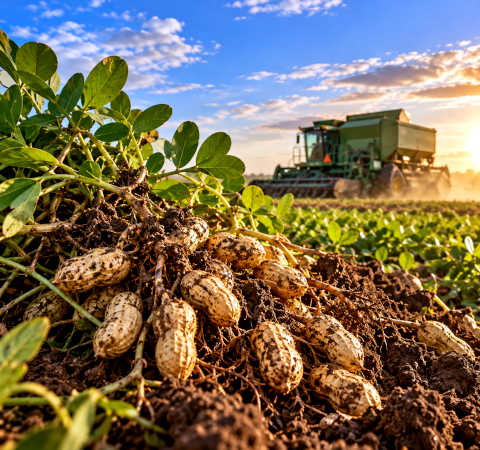
Texas peanut growers adjust to market and weather in 2026
By Kay Ledbetter
Texas AgriLife
Texas peanut producers made careful planting choices in 2026, responding to both market signals and a dry outlook, according to Texas A&M AgriLife Extension Service experts.
The U.S. Department of Agriculture Farm Service Agency peanut acreage report released Sept. 11 shows about 145,000 acres of peanuts planted this year in Texas, down from 2025.
Several factors drove the shift, said Emi Kimura, Ph.D., AgriLife Extension agronomist at the Texas A&M AgriLife Research and Extension Center at Vernon and professor in the Department of Soil and Crop Sciences.
The biggest factor was an exceptional 2025 crop, which left a larger-than-normal supply of peanuts and put downward pressure on prices.
Two other considerations were more favorable prices on other commodities at planting time and the weather outlook, Kimura said.
Peanuts require good moisture, and the state was entering a very dry period, so many producers chose to plant more drought-tolerant crops as a result.
Bob Whitney, Regents Fellow and AgriLife Extension organic specialist with the Texas A&M AgriLife Research and Extension Center at Stephenville in the Department of Agricultural Economics, reported organic peanut acreage followed the same trend, falling 25% from 2025, as prices for organic peanuts dropped 25%.
**A long stretch of heat**
Growers who planted peanuts had to manage a demanding summer because peanuts slow their activity when daytime highs rise above 95 degrees.
Temperatures stayed above that mark from July 21 through Sept. 18 in much of the peanut-growing regions, Kimura said, so they experienced about 60 days of continuous stress.
A few days dipped into the 80s, but not enough to break the stress. And nighttime temperatures stayed high as well.
“The peanuts just didn’t get a rest,” Whitney said.
**Low disease pressure so far**
The hot, dry weather brought one clear benefit. High temperatures and low humidity kept disease pressure low this season.
Kimura said the only disease issues were minor leaf spot damage and pod rot in an early planted trial in Wilbarger County and some spider mite pressure in drought-stress trials at Stephenville. This could mean producers with drought-stressed fields faced similar challenges.
Recent rainfall and cooler nights offered relief from the heat; however, she warned these conditions can also create a favorable climate for disease.
If harvest is still several weeks away, producers may need to treat fields. Growers who have noted diseases in a field during previous seasons should be extra cautious. Kimura advised growers to check chemical labels before applying.
**Harvest outlook**
Some producers in the Rolling Plains and West Texas have begun digging, depending on crop maturity. South Texas growers will likely wait until the end of October or November.
With rain in this week’s forecast, Kimura said the majority of peanut digging will begin once fields dry out. At the same time, producers are keeping an eye on the approaching colder weather and possible frost to time their harvest.
She said the overall quality will become clearer after harvest. Yields should be good where growers had irrigation water and managed it well.
The crop needed more water this year than in past seasons, she said, but most growers did not have enough to keep up.
That challenge is exactly why Texas A&M AgriLife Research breeders like Johnny Cason, Ph.D., at the Texas A&M AgriLife Research and Extension Center in Stephenville, are developing drought-stress tolerant peanut lines. His work aims to give Texas producers more options in dry years ahead.
AgriLife Extension district reporters compiled the following summaries:
**PANHANDLE**
Cooler, wetter weather moved across the district, and widespread rains stopped fieldwork. Precipitation totaled about 1 inch in most areas, with amounts varying from just under 0.5 inch to more than 4 inches. Some of the district still needed more rain.
Topsoil and subsoil moisture levels were very short to adequate. Corn was in very poor to poor condition, and forage choppers continued to harvest remaining fields of later-planted corn.
Sorghum and cotton were in poor to fair condition. A few fields of forage sorghum that reached desired growth and maturity were chopped for silage.
Most cotton fields were on track for slightly earlier maturity as lower- to mid-canopy bolls opened, which reporters attributed to the run of 100-degree days during August.
Growers sowed more acres of wheat and oats ahead of the rain. Livestock, pasture and rangeland conditions were very poor to good.
**SOUTH PLAINS**
A storm system moved through over multiple days and delivered 1-4 inches of rain across much of the district. Several areas reported more than 4 inches while other parts of the district remained dry.
Cooler temperatures came with the moisture, and topsoil and subsoil moisture levels were very short to surplus overall. Fieldwork stopped once the rain began.
Corn and sorghum were in very poor to fair condition, and harvest of both stalled in wet fields. Cotton was in very poor to fair condition and continued toward maturity.
Cotton harvest ramped up in some areas while producers elsewhere prepped harvest equipment. Peanuts were in good condition and nearing maturity.
Winter wheat planting was underway but paused due to the heavy rain. Preparations for planting winter small grains were expected to continue once fields dried.
Showers helped winter wheat, pasture grass and stock tanks in some areas. Pasture and rangeland conditions were very poor to fair, and forage availability remained inadequate to support grazing. Livestock conditions were very poor to good.
**ROLLING PLAINS**
Hot, humid days continued with spotty rain across much of the district. Rain totals ranged from trace amounts to nearly 0.75 of an inch. Temperatures were moderate.
Topsoil and subsoil moisture levels were very short to adequate, and the rain did little to change the overall drought conditions.
Cotton was in very poor to poor condition, and irrigated fields began opening on a few acres. Most dryland acres were lost.
Corn was in very poor to poor condition, and sorghum conditions were very poor.
Winter wheat planting picked up, with many producers dusting seed into the field ahead of forecast rain. There was concern that the light rain could sprout seeds without supporting strong stand establishment.
Pasture and rangeland conditions were very poor to fair. Livestock conditions were very poor to good, and cattle were fed cake and hay due to poor grazing.
Calves continued to be moved to market while cattle producers tried to hold breeding animals in hope of a wetter fall.
For the full story SUBSCRIBE to the online edition of The Dalhart Texan, call (806) 244-4511 to setup a subscription to our physical paper or pick a copy up at one of our many convenient news rack locations. You can also stop by and purchase a paper or subscription in person at our news office located at 410 Denrock Ave.

